
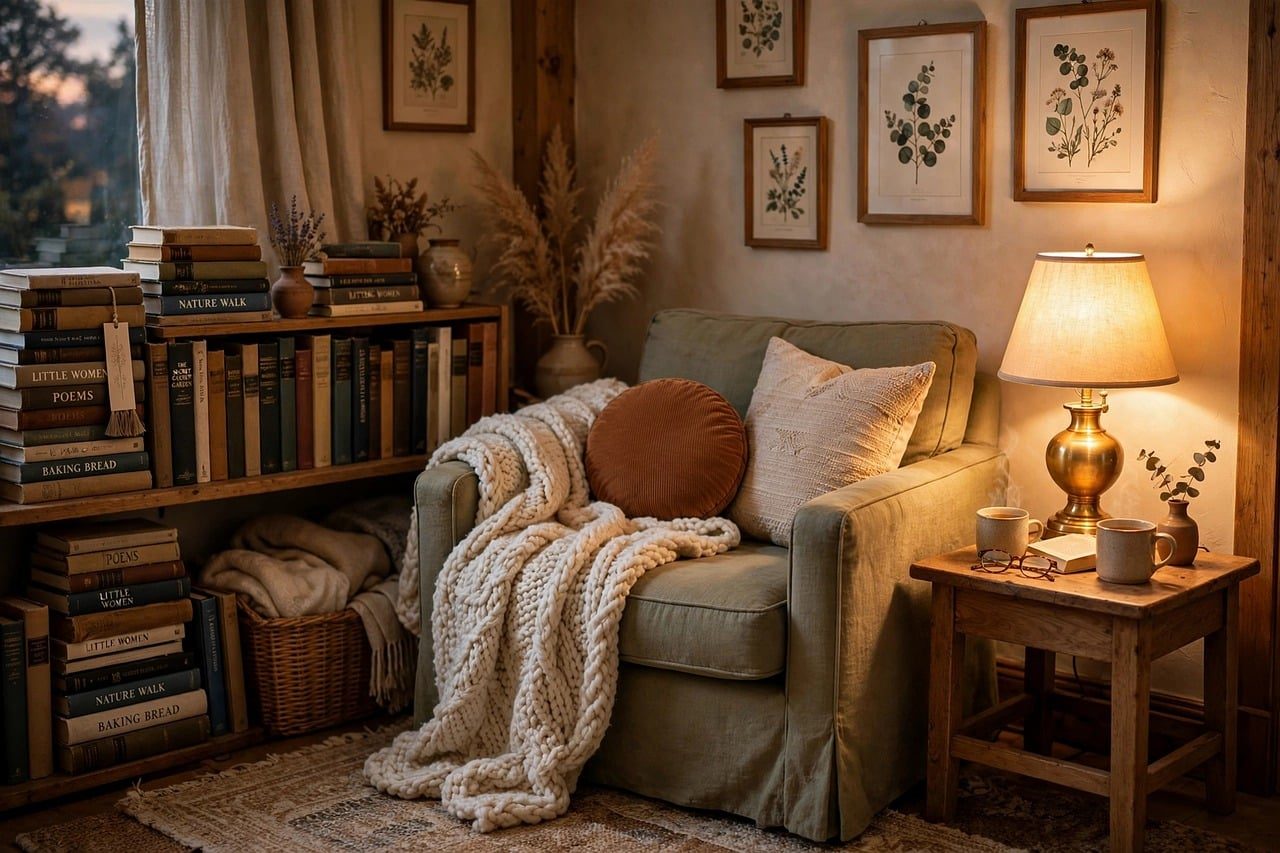
Some forms of screen time warm you, and some forms of puzzling settle you, but they often arrive together. The word cozy gives the screen side a dictionary anchor: Cambridge’s US entry places it under the comfortable heading, with the example “The living room is warm and cozy.” A free crossword gives the other side a boundary: a short clue, a defined answer length, and no requirement to create an account.
What cozy means when a story wears it
Cambridge’s US dictionary entry for cozy lists the comfortable sense and the example “The living room is warm and cozy.” The same page includes a noun for stories, marked mainly US specialized, and gives the literature example: “The novels aren’t cozies, police procedurals, or thrillers — they’re well written novels about wonderfully engaging characters who happen to get into trouble.” The UK page adds a line from its corpus: “The supporting characters in cozy mysteries are often very broadly drawn and used as comic relief.” That tonal marker matters for viewers: the crime may be present, but the frame around it is intentionally warm and contained. Synonyms in the US entry include comfortable, comfy, snug, and homey, all pointing toward the same low-stakes comfort.
The clue format on a puzzle page
The New Yorker’s puzzle page in early November 2026 shows how a broad reference becomes testable. The Friday mini asks for a “solar-system body demoted to dwarf planet, in 2006” in five letters; the Thursday mini asks for the “Maya who designed the Vietnam Veterans Memorial” in three letters. Other clues state an eight-letter demand, such as “Black feminist scholar Spillers” or “Concept in Gramscian Marxism.” The consistent thread is a clue plus an answer length, which turns a screen or scholarly reference into a checkable pattern. For open-ended practice, Boatload Puzzles calls itself “the home of the world’s largest supply of crossword puzzles,” with 300,000 free online crosswords, newly expanded and edited in 2026, and no daily limits, subscriptions, or account registrations. A separate Classic collection is also available for an easier path.
Why the bounded grid becomes a mental pause
The wellness value sits less in the puzzle’s difficulty than in its self-contained shape. When you know the answer is five letters and one crossing square is already filled, the problem narrows enough to become a short mental warm-up rather than an open-ended worry. The clues range from a direct definition to an indirect reference, so you practice holding one small fact in mind while checking it against another. Free access without registration removes the usual activation cost, making a ten-minute puzzle an easy companion to a quiet evening rather than another account to manage.
When the clue moves from suspects to mythology
Sometimes a clue moves from screen vocabulary to a different register, and the answer is not an alibi but a goddess. Gudinde Krydsord is a Danish-language resource for searching goddess names by letter count, known fields, and mythology, aimed specifically at crossword solvers. It arranges documented goddess names by letter count and lets you check a candidate against the crossing words, which is the same slow verification the screen mystery teaches in miniature: trust the letters you already have, and let the unknown square reveal itself.
Put the warm frame next to a smaller grid
Begin with the dictionary’s comfortable definition as your frame: if a story is warm and its characters are broadly drawn, the cozy label is doing its work. Then carry that shape to a free crossword, using the letter count and the crossing answers as your guides. Neither the screen story nor the puzzle demands a subscription, and both reward the same unhurried attention. When the clue turns to mythology rather than suspects, a language-specific look-up can hold the next step until the pattern clears.